

Constants vs Kajabi: A Free Storefront vs an $89-a-Month Course Platform

Kajabi and Constants both let you sell to your audience online, but one bills you every month whether you sell anything or not, and the other doesn't.
What Kajabi Actually Is
Kajabi is an all-in-one platform for building and selling online courses — course hosting with drip-fed lessons, email marketing, sales funnels, and community features bundled into one subscription. It's built for creators running a real course or coaching business, not a single downloadable file.
What Kajabi Charges
Kajabi has no free plan. Plans start at $89 a month for a legacy Kickstarter tier when it's available, or $179 a month for Basic, running up to $499 a month for Pro — and Kajabi raised these prices in January 2026 for the first time in a decade. There's no revenue share on top: Kajabi doesn't take a percentage of sales, just standard card processing around 2.7–2.9% plus $0.30 depending on plan. The bill arrives whether a creator sells one course or none that month.
What Constants Charges
Constants is free to start on the Starter plan, with a flat 6% fee on one-time sales and 10% on subscriptions — no monthly bill either way. The fee only shows up when a sale actually happens, so a slow month costs nothing beyond the usual card processing built into that 6% or 10%.
The Math on a Slow Month
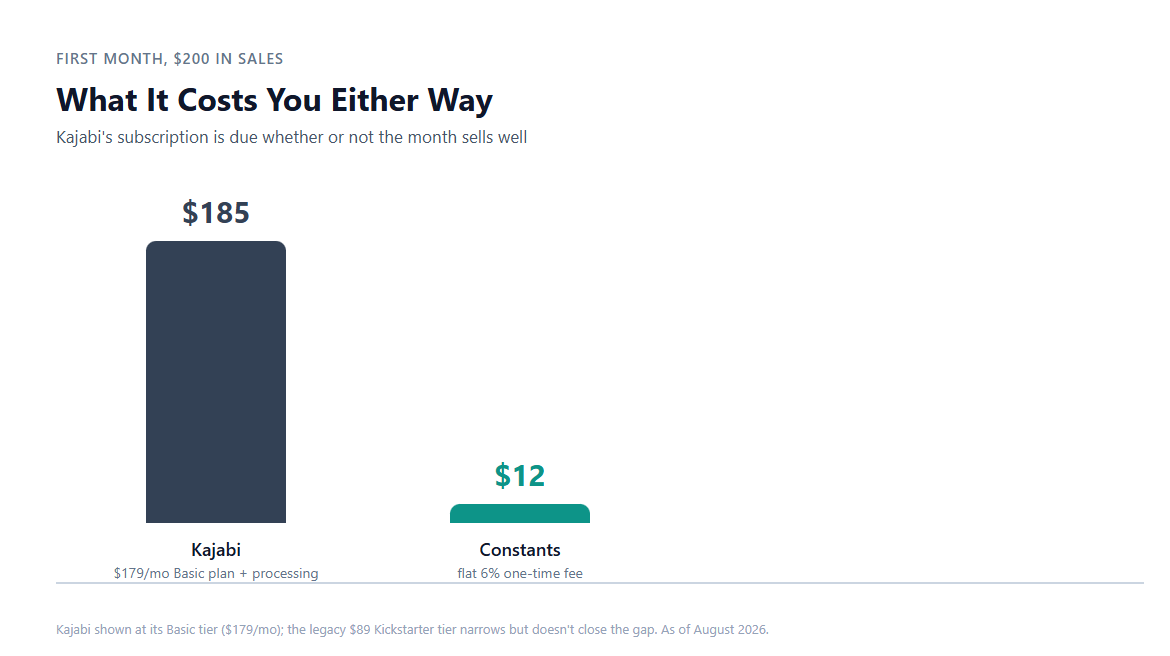
Say a first course launch brings in $200 in its opening month. On Kajabi's cheapest available plan — the legacy Kickstarter tier at $89, or Basic at $179 if that's not open — the subscription alone can cost more than the sales it produced, before processing fees are even added. On Constants, that same $200 in one-time sales costs a flat $12 in fees, leaving $188, because there's no bill due when sales are slow. The math does flip at real volume: somewhere around $5,800 a month in sales, a flat subscription like Kajabi's starts costing less than a percentage fee. That's a good problem to revisit later, not a reason to pay for it up front — most people testing their first digital product aren't there yet, and Constants' free plan means finding out doesn't cost anything until it happens.
Different Jobs, Not Just Different Prices
To be fair both ways: Kajabi is genuinely built for hosting a real course — drip-fed lessons, quizzes, student progress tracking, email sequences, and marketing funnels, all under one login. Constants doesn't do any of that. Digital products on Constants cap out at 32MB and a fixed list of file types, which fits an ebook, a template pack, or a single workshop recording, not a multi-module video course with dozens of lessons. If the plan is genuinely a structured, multi-lesson course business, that's Kajabi's job to do. Everything short of that — a single guide, a template, a workshop recording, a first paid product to test demand — is exactly what Constants is built for, without a subscription bill while that's still being figured out.
Pick Constants If, Pick Kajabi If
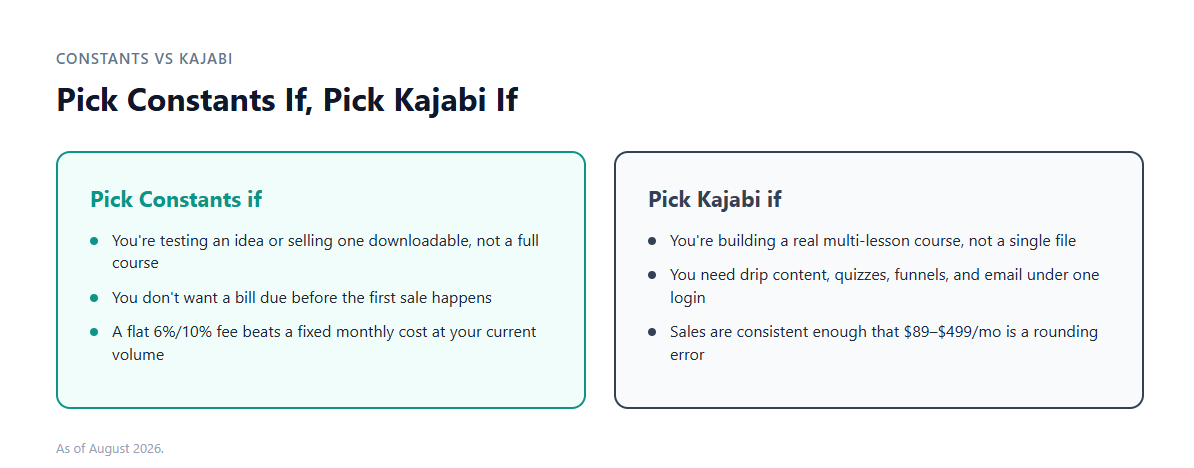
Pick Constants for testing an idea, selling a single downloadable, or running a booking or membership page without committing to a monthly bill before the first sale. Pick Kajabi once there's an actual course — multiple lessons, a real curriculum, an audience big enough that the $89-to-$499 subscription is a rounding error next to what it sells. Short of that point, Constants is the cheaper place to find out whether the idea sells at all.
The full pricing page has the exact numbers for every plan, and the decision-hub guide walks through picking the right tool across every product type Constants supports if a single downloadable is closer to the real plan than a full course.