

Constants vs Patreon: The Fee Is Nearly Identical — the Page Isn't

Patreon and Constants both let an audience pay you directly, but they're built around a different core action — Patreon expects a monthly pledge, Constants expects a sale. The fee gap between them is smaller than you'd think; the page around it isn't.
What Patreon Actually Is
Patreon started as monthly membership tiers for podcasters, artists, and writers, and it's still built around that: supporters pick a tier, pay every month, and get access to posts, community chat, and perks behind a paywall. Patreon added one-time purchases later — a single digital file, a single post, a bundle — sold to anyone, member or not.
What Patreon Charges
New creators — anyone who joined after August 2025 — pay a flat 10% platform fee on everything they earn, memberships and one-time purchases alike, plus standard card processing around 2.9% + $0.30 (or 5% + $0.10 on pledges of $3 or less), plus a payout fee when the balance moves to a bank account or PayPal. Patreon is free to join; the fee only shows up once money moves. Creators who joined before August 2025 keep older tiered rates — 5%, 8%, or 11% — for as long as their page stays published, but that grandfathering doesn't apply to anyone signing up today.
What Constants Charges
Constants also has one free Starter plan, with a flat 6% fee on one-time sales and 10% on subscriptions — the same card processing applies, and there's no separate fee to withdraw a balance. Current plan details are at https://constants.com/pricing.
The Math, Both Ways
Say 100 supporters pledge $5 a month — $500 total. Patreon's 10% platform fee is $50; card processing on a hundred separate $5 charges runs about $44.50 (2.9% plus $0.30 each). That's $94.50 in costs, leaving $405.50, before any payout fee to move it to a bank account. Constants charges the same 10% subscription fee and the same processing — $94.50 in costs, $405.50 left. On memberships, the platform fee is a wash; Constants' only edge is not charging anything extra to withdraw it.
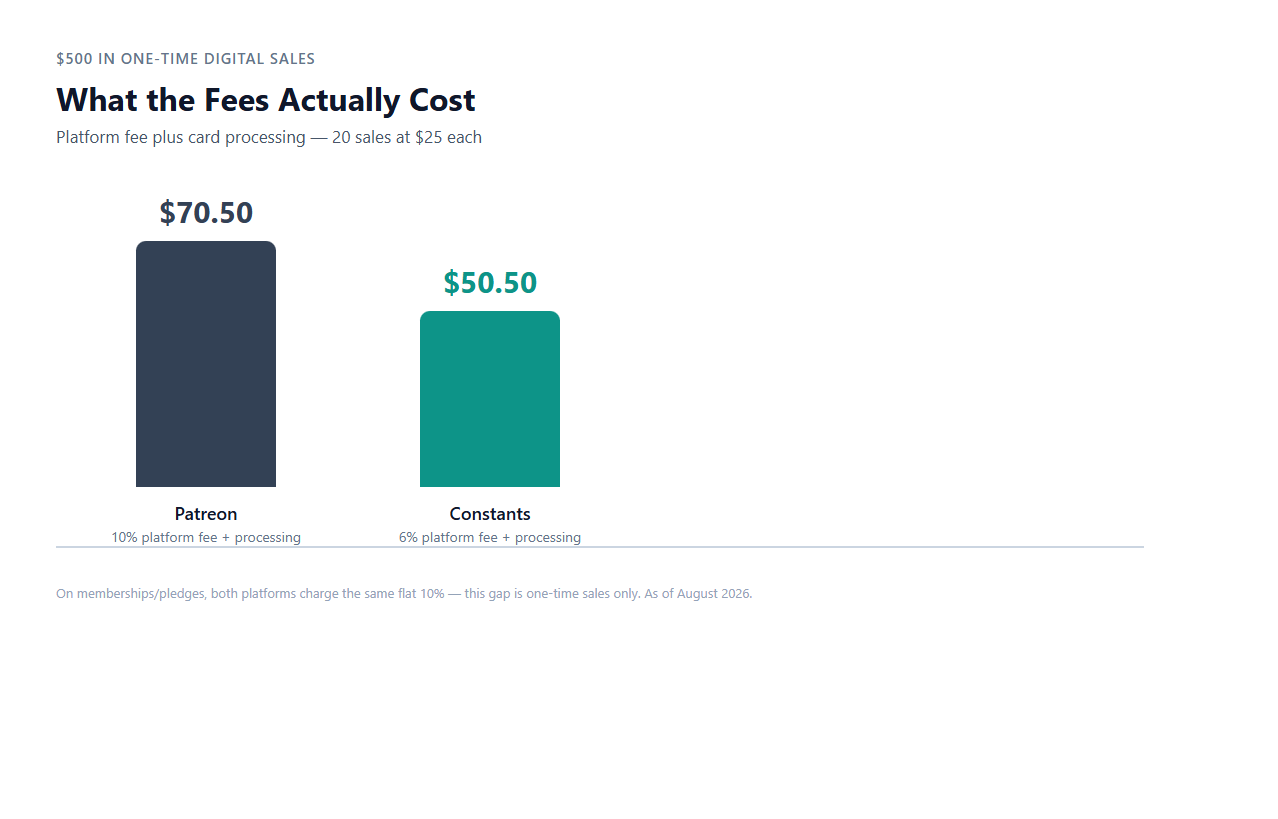
Say that same $500 comes from selling 20 copies of a $25 digital guide instead. Patreon's 10% fee is $50, processing on 20 sales runs about $20.50, total costs $70.50, leaving $429.50. Constants' 6% fee is $30, the same $20.50 processing, $50.50 in costs, leaving $449.50 — about $20 more on a single month of one-time sales, and the gap only grows with volume.
Where Patreon Is Strong
To be fair both ways: Patreon has the name recognition and the years of habit behind it. Millions of people already have a Patreon account, already know how a pledge works, and already trust the checkout — for a creator with an existing following used to seeing a Patreon link, that familiarity removes friction Constants doesn't have yet. Patreon's tier and perk system is also more built out for a pure membership business: multiple pledge levels, gated posts, polls, and a built-in content feed for paying members. None of that disappears by picking Constants instead — it just means a page already living inside Patreon's ecosystem has less reason to leave, while a creator starting from zero has nothing tying them to it either.
Where Constants Is Different
Constants doesn't assume the relationship is a monthly pledge. The same page that hosts a membership can also sell a single download, take a booking, or run a one-time event, and none of those add a second fee schedule to learn. Buyers can follow the creator and join the community from the same link they bought from, so a one-time sale isn't a dead end, and because content and products share the same address, the page can build search presence over time instead of living entirely inside Patreon's own app.
Pick Constants If, Pick Patreon If
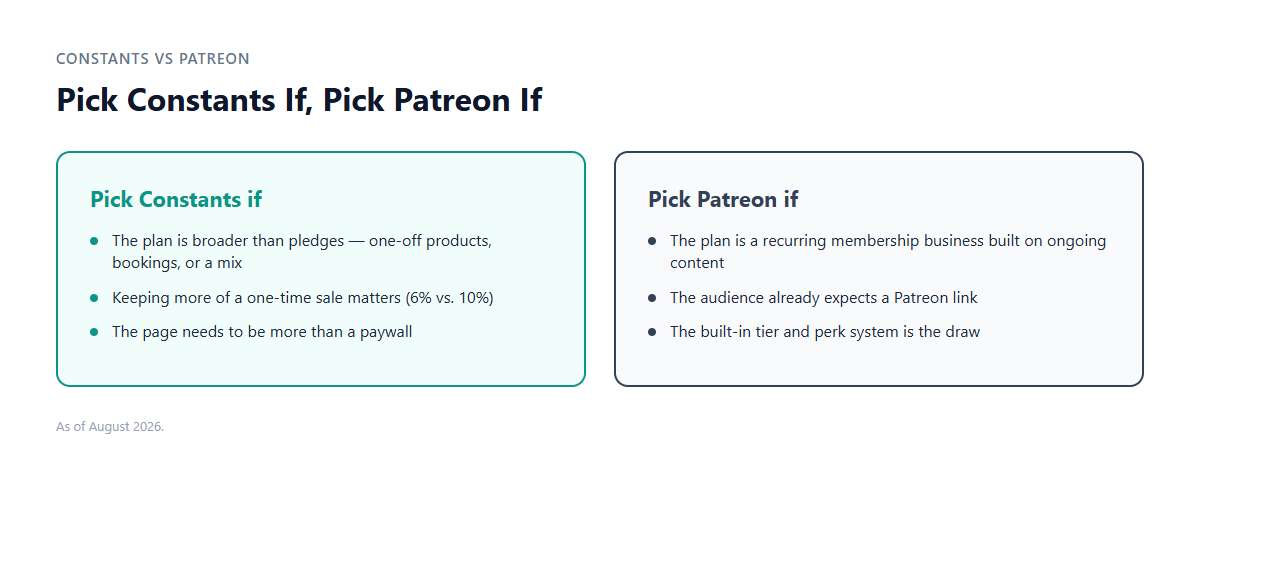
Pick Patreon if the plan is a recurring membership business built around ongoing content, an audience that already expects a Patreon link, or the built-in tier and perk system. Pick Constants if the plan is broader than pledges — one-off products, bookings, or a mix — and keeping more of a one-time sale matters, or the page needs to be more than a paywall. Either way, claiming a Constants handle costs nothing, so the cheapest way to compare is to see what your own numbers look like on both.
Weighing more link-in-bio options than these two? Our five-platform roundup puts Constants up against Stan, Gumroad, Beacons, and Linktree at https://constants.com/u/constants/article/2372/stan_store_is_a_polished_way_to_sell_from_your. Selling a membership for the first time? Here's the setup walkthrough: https://constants.com/u/constants/article/2409/selling_memberships_from_your_link_in_bio_turns_oneoff_followers.