
Constants vs Carrd: Which Simple Link Page Actually Sells?

Carrd earned its reputation by making one thing extremely well: a beautiful, fast, one-page site you can spin up in an afternoon.
If you just need somewhere to point people from Instagram, it's hard to beat. But a beautiful page and a page that actually sells something are two different products, and creators who outgrow Carrd usually hit that wall the same way.
What Carrd actually is
Carrd is a website builder, not a commerce platform. You drag in text, images, and links, publish, and you're done. The free plan puts your page on a carrd.co subdomain with Carrd's own branding. Pro Lite removes that branding for $9/year but still has no custom domain. Pro Standard, at $19/year, adds a custom domain and forms. Pro Plus runs $49/year and adds advanced forms plus password protection. None of the tiers include a built-in shop, checkout, or payment processing, so selling anything means embedding a third-party tool like a Stripe payment link or Gumroad button into a Carrd widget block.
Where the money question comes in
That's fine if all you need is a link list. It gets awkward the moment you want to sell a digital download, book a paid call, or run a membership. On Carrd, each of those needs its own separate service, its own login, and usually its own monthly fee, all wired into one Carrd page through embed widgets that have to be maintained separately from the page itself.
Constants folds all three into the page. You add a digital product, a booking type, or a membership tier the same way you'd add a link, and it shows up in your shop with no second account and no second subscription. Check the digital downloads guide for the exact setup if that's the product type you're after. The free Starter plan can sell right away, no upgrade required just to accept a payment, unlike Carrd, where you need Pro Standard just to attach a custom domain in the first place.
Setting up to actually sell
On Carrd, adding a product means picking a payment provider first, creating an account there, building the checkout separately, then linking or embedding it into a widget block on the page, three tools working together for one sale. On Constants, you create the item inside the same dashboard you already use to edit your page, set a price, and it's live in the shop section automatically, with the 6% platform fee and card processing already built in. There's no separate provider to configure and no embed code to keep working after a template update breaks it.
The honest tradeoff
Constants isn't free money either: like every plan, it takes a flat 6% platform fee on sales, on top of standard card processing. If your bio page is genuinely just a link list, no products, no bookings, nothing to sell, Carrd's $9-$19/year is cheaper than anything charging a percentage, and its design flexibility still beats most link-in-bio tools, Constants included. Carrd wins outright on pure page design freedom for a page with nothing to sell.
Where Constants pulls ahead is the moment selling enters the picture. A creator doing $500 a month in digital product sales pays Constants roughly $30 in platform fees and keeps the rest, with no separate embedded-checkout subscription stacked on top of the page itself. The same creator on Carrd is paying $19-$49/year for the page, then whatever the embedded checkout tool charges on every sale, Gumroad alone runs 10% + $0.50 per transaction before Carrd's own cost is even counted.

Which one to pick
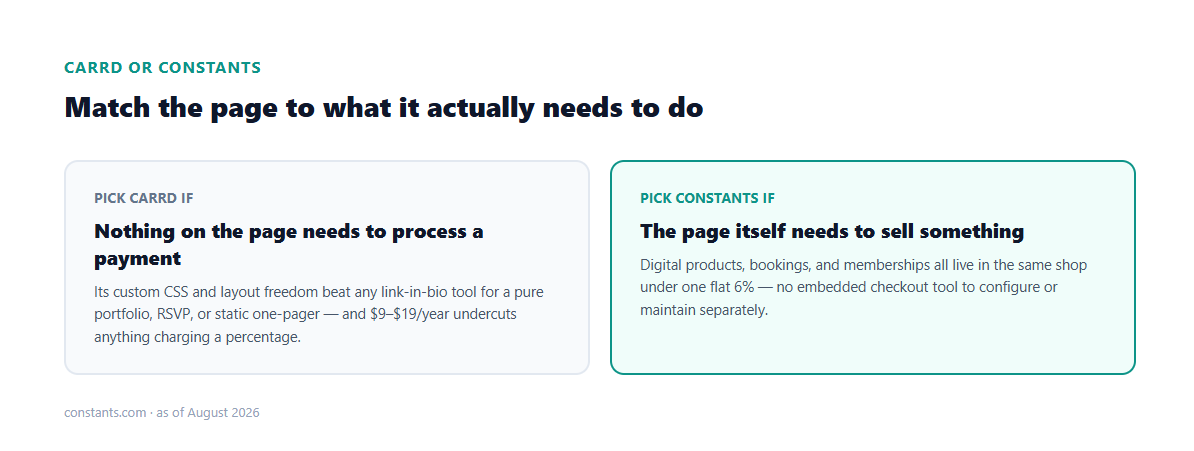
Pick Carrd if you want a fully custom-designed one-pager and nothing on it needs to process a payment, a portfolio, an event RSVP page, a simple contact form. Pick Constants if the bio page itself needs to sell something: a digital product, a paid booking, a membership, or all three from the same page. For a broader look at how Constants stacks up against the rest of the link-in-bio field, see the full comparison of link-in-bio tools; for exactly what's included on each Constants plan, check the pricing page.