

AI Agents Are Learning to Act For You. Yours Might Already Be on Your Bio Page.

OpenAI's GPT-6 Astra launched this week promising something bigger than a smarter chatbot: an AI that can use a computer on your behalf, working through spreadsheets, filling out forms, and moving across web pages the way a person would, at API pricing of $10 per million input tokens and $50 per million output tokens. It's a genuine jump in what these systems can do. It's also not as far from where creators already are as the headlines make it sound.
The shift underneath the headline
The interesting part of Astra isn't the benchmark scores. It's the shift from an assistant that answers questions to an agent that acts, reading a form, deciding what goes where, and getting it done without a person walking through every step by hand. That shift has been building for a while, and it didn't start with one model release. It's already showing up in smaller, more specific places, including the page creators use to sell what they know.
An agent that already lives on your page
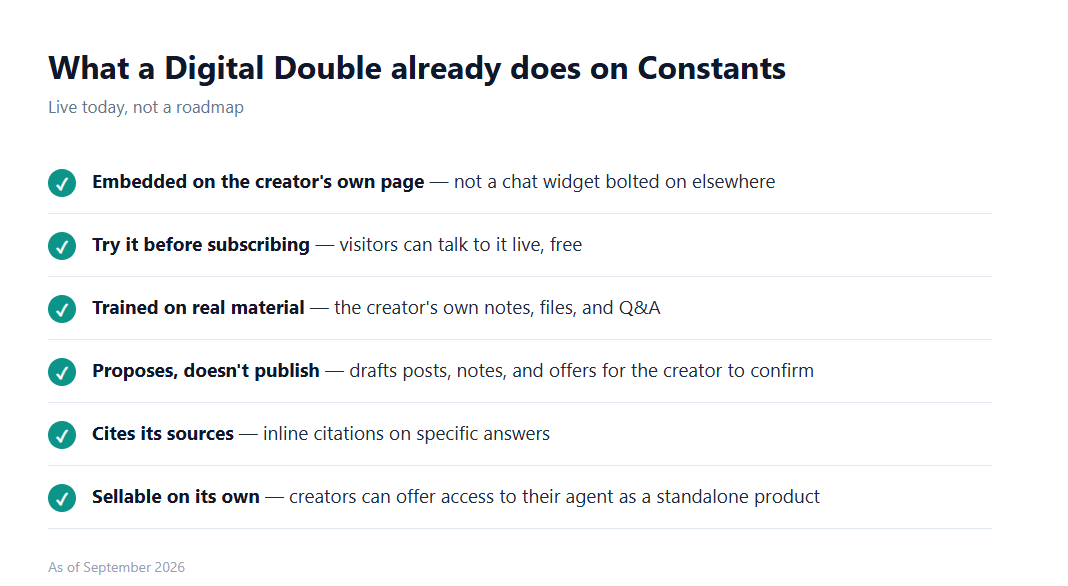
On Constants, a creator's page can carry its own AI agent, a Digital Double trained on that person's own content, offers, and audience, embedded directly where visitors land. It isn't a general assistant bolted onto a chat window. It's scoped to one person's actual work.
A visitor doesn't have to take that on faith, either. Before subscribing to anything, they can try the agent directly on the page, ask it something, and see how it answers. The agent draws on whatever the creator has actually put into it, uploaded notes, files, and a Q&A section it can search, so answers come from real material instead of a generic script. When it answers from something specific, it says so with an inline citation, so a creator can see exactly what it pulled from.
Say a creator sells one-on-one coaching calls and has fifty notes on how they actually run a session. A visitor asking their agent what's included isn't getting a canned FAQ. They're getting an answer grounded in what that specific creator actually wrote down, with a citation attached, before anyone has paid for anything.
What acting on your behalf looks like at this scale
Astra's headline trick is doing things across a whole computer. A creator's agent works at a smaller, more specific scale: with the creator's approval, it can draft a post, capture a note, or put together an offer, surfaced as a proposal the creator confirms before anything goes live. Nothing publishes itself. The agent proposes, the person decides. That's a narrower version of acting on your behalf than a model that can drive an entire desktop, and for a business built around one person's voice and judgment, narrower is the point, not a limitation.
Same shift, different scope
None of this is a race with GPT-6 Astra, and framing it that way would miss what's actually useful here. Astra is a general-purpose model with a broad footprint, priced per token and built to work across any computer, any task. A creator's agent is scoped on purpose: one person's content, one page, one audience. It comes with every Constants plan on a starter credit allowance; what unlocks unlimited use and deeper reasoning modes is laid out on the pricing page.
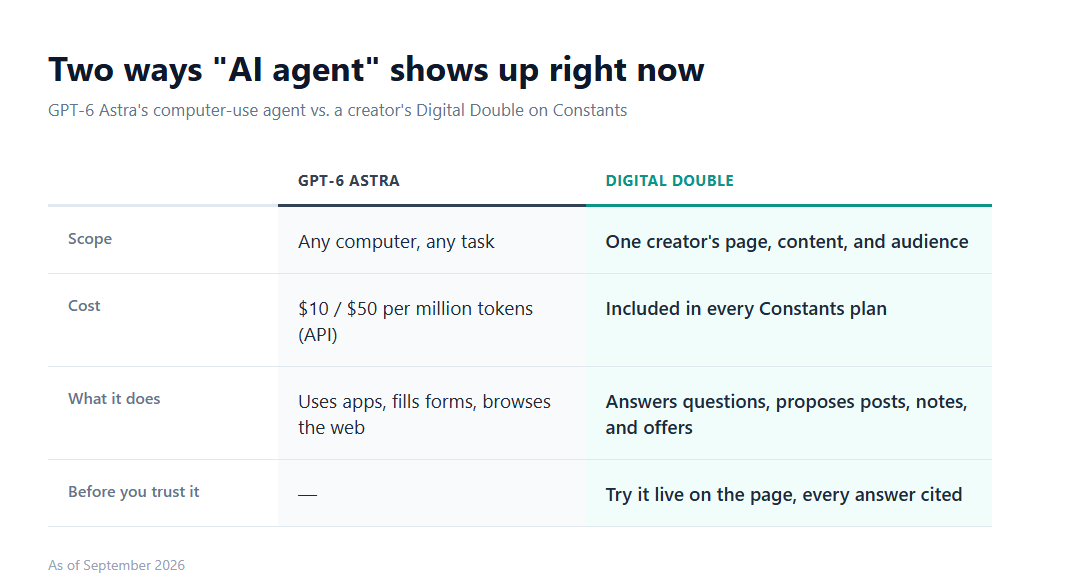
The bigger AI news cycle is going to keep being about what a model can technically do next. For creators, the more useful question is narrower: does an agent trained on your actual work help someone decide to trust you, buy from you, or come back. That's the version of an AI agent that's already live on Constants, not a preview of what's coming.